 |
|
|
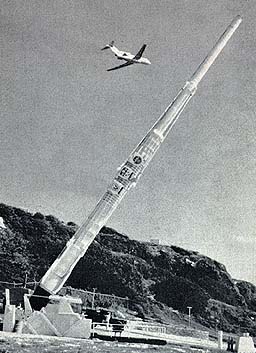
Long before the first test flights of the V-2, the Paris Gun of World War I set impressive altitude and speed records for artificial objects. In the 1950s, as the rocket became established as the primary means of reaching space, Canadian engineer Gerald Bull began a lifelong struggle to use guns for cheap access to the high atmosphere and Earth orbit. His Project HARP (High Altitude Research project) in the 1960s showed that a suborbital cannon can be cost-effective for studying the upper atmosphere, between 50 km and 130km, and has the potential to launch vast numbers of satellites each year in all kinds of weather. A further development of this concept was Lawrence Livermore Lab's Project SHARP (Super High Altitude Research project).
Even if shot out of an extremely powerful cannon, a projectile would need to include a rocket in order to enter a stable orbit. This is for two reasons. First, reaching orbital velocity (with an extra margin for air resistance) is difficult using a cannon alone. Second, by Kepler's first law, any orbit is an ellipse with one focus at the Earth' s center. If the payload is launched from a point A on the Earth' s surface, its orbit necessarily would intersect the surface again at a symmetrically placed point B. An orbital adjustment is therefore essential.
Plans also exist for accelerating a payload by magnetic forces on a "rail gun" consisting of parallel conductors, into which a very large electric current is directed. The same problems apply here, plus the added one of storing and then suddenly releasing a great amount of electrical energy. This kind of technology might be appropriate for future use on the Moon but is at an even earlier stage than the space cannon.